Enquiries
General
info@joycewangstudio.com
New Business
info@joycewangstudio.com
Press
laura@lbagency.co
London
1 Warren Mews
London. W1T 6AJ
T +44(0)20 7436 8846
Hong Kong
Ground Floor
12 Kennedy Street
Wan Chai
Hong Kong
T +852 2804 1138

In Conversation with the Collaborators Reshaping the Landmark Mandarin Oriental
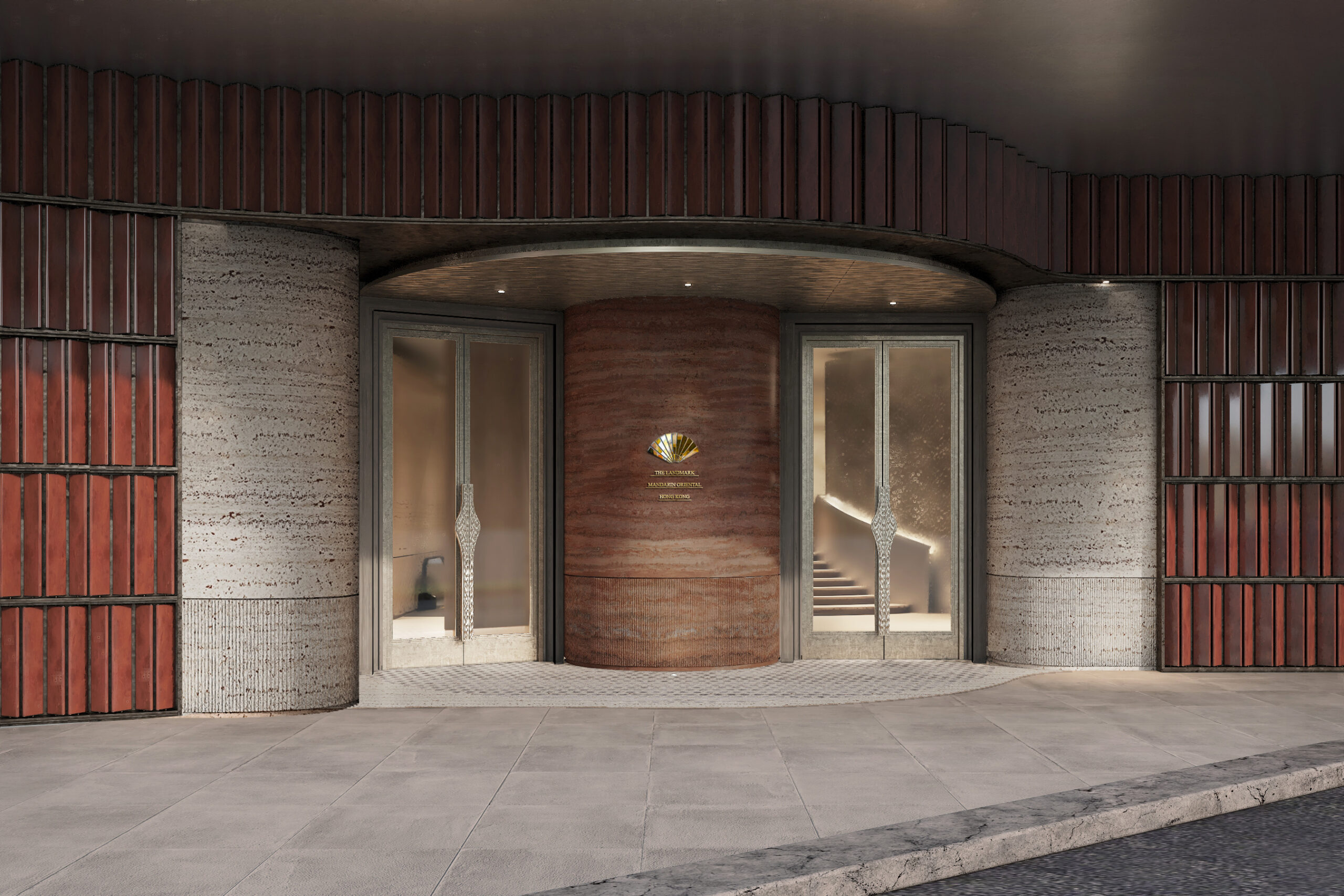
The Landmark Mandarin Oriental Hong Kong is nearing its relaunch, and we’re taking you behind the scenes. While so much of our work unfolds over years, we thought it was time to share a different perspective- through the architects who shape the buildings that house our interiors. Scroll through to explore their thinking, and see how their vision informs ours, starting with Neri & Hu’s approach to the Landmark façade and lower-level entrance. By highlighting the dialogue between architecture and interior design, we invite you to see not just the finished space, but the creative process that bridges structure, materiality, and atmosphere- revealing how collaboration transforms a building into an immersive experience.
01
Founding Partner Lyndon Neri on Creating a Civic Presence in Hospitality
Can you share a hidden or surprising detail from the façade you created at the Landmark Mandarin Oriental?
What surprises me most is that we’ve managed to create something that feels civic within a hospitality setting. Our goal was to establish a civic presence along Queen’s Road while also making it feel genuinely inviting to the community. We wanted to give The Landmark Mandarin Oriental a lasting presence, introducing a sense of domesticity to a bustling street otherwise defined by glass towers. At the same time, we conceived a light, screen-like form that subtly evokes the hotel’s iconic fan. Perhaps the most unexpected detail of all is that we achieved this using different shades of red.
How would you describe the mood of the project in three words?
Monumental, complex, and rigorous.
What detail in the façade did you secretly hope we might pick up on?
The angle and the different shades of red were extremely challenging to execute. We hope that over time, the community will notice how the light shifts across the surface, revealing the different reflections, shadows, and tones of this monolithic screen.
What came to mind when you found out we would be working together on this project? Be honest 🙂
We have always admired your work and ethos of what you and your practice stands for . The attention to detail and the sense of layering in your spaces resonates deeply with how we approach our own interiors, so naturally, we were thrilled to finally have the opportunity to collaborate. Equally important to us is the honesty of materials and the clarity of the studio’s tectonics. This is something very consistent in your work, and we felt an immediate creative kinship.
What’s one thing you’re curious about and one thing you’re coveting right now?
We are curious about many things from ecology and philosophy to anything culture-related. Beyond our practice, we have remained deeply committed to research and teaching since we started the studio. Rossana is now the Chair of Architecture at the University of Pennsylvania, and I have been teaching an advanced design studio at Princeton and Harvard for the last ten years. In many ways, this allows us to satisfy our insatiable curiosity about pressing issues related to sustainability, materiality, culture, and philosophy.
As for what I covet? We are always looking for balance, and amidst the noise, we are often in pursuit of peace and joy in our lives. Time for each other and for family. We are not sure if that qualifies as coveting, but this balance is certainly something we seek every day.
Lyndon Neri, Founding Partner
郭锡恩 创始合伙人
02
Art Consultant Alex Toledano Finds the Right Voice for Each Space
Can you share anything distinct about our collaboration that surprised you?
Joyce doesn’t comment, she converses. We really feel like we are working with a partner who cares as much about the art as we do, and can engage deeply, like a member of our own team. That is somethine rare. It pushes us to improve the work, which tremendously benefits the project.
What piece are you the most excited about? And why?
We are working with a local Hong Kong label maker for a custom piece. Who knew that there is still a label maker left in Hong Kong! Joyce did. She set us on the trail, for which we are so grateful. It is an amazing story, that this label maker for high-fashion brands, all represented in Landmark, can also create works of art. It gets deep into the story of the property and couldn’t be more authentic.
If the art could talk, what would it say to each guest as they journey through the spaces?
I actually think the art would ask the guest what they have to say. It is that type of meditative collection that asks questions, evokes responses, it doesn’t speak too loudly but it penetrates all the same. The artworks are really a residential collection, and each guest will have unique feelings about how they might have collected or come across these works. Because these works belong to the guest in many senses—as part of their travels and experiences—they are bringing them home.
Did you have an emotional as well as aesthetic brief?
The aesthetic brief is super clear, the emotional one is more powerful but less defined. And that is the way it needs to be. We need to feel the old mansions of Hong Kong, the modern commerce, the transitions, the moments of respite. Translating that into not just one emotion, but many, is the most complex and rewarding part of the work. We always feel first and then figure out why after to try and explain ourselves. We are those feelings. Our articulations of those emotions offer different angles and reflections into who we are, how we communicate ourselves to the world.
Can you share anything distinct about our collaboration that surprised you?
Joyce doesn’t comment, she converses. We really feel like we are working with a partner who cares as much about the art as we do, and can engage deeply, like a member of our own team. That is somethine rare. It pushes us to improve the work, which tremendously benefits the project.
What piece are you the most excited about? And why?
We are working with a local Hong Kong label maker for a custom piece. Who knew that there is still a label maker left in Hong Kong! Joyce did. She set us on the trail, for which we are so grateful. It is an amazing story, that this label maker for high-fashion brands, all represented in Landmark, can also create works of art. It gets deep into the story of the property and couldn’t be more authentic.
If the art could talk, what would it say to each guest as they journey through the spaces?
I actually think the art would ask the guest what they have to say. It is that type of meditative collection that asks questions, evokes responses, it doesn’t speak too loudly but it penetrates all the same. The artworks are really a residential collection, and each guest will have unique feelings about how they might have collected or come across these works. Because these works belong to the guest in many senses—as part of their travels and experiences—they are bringing them home.
Did you have an emotional as well as aesthetic brief?
The aesthetic brief is super clear, the emotional one is more powerful but less defined. And that is the way it needs to be. We need to feel the old mansions of Hong Kong, the modern commerce, the transitions, the moments of respite. Translating that into not just one emotion, but many, is the most complex and rewarding part of the work. We always feel first and then figure out why after to try and explain ourselves. We are those feelings. Our articulations of those emotions offer different angles and reflections into who we are, how we communicate ourselves to the world.
03
Michelin-Starred Chef Richard Ekkebus on the Ritual of Coffee in Hotels
We’re saying a fond farewell to the beloved MO bar. For guests after that daily fix of coffee and cocktails, what will the new espresso bar offer up?
Mo bar was an incredible place; it was the local meeting points for the central community. Commune is certainly not a replacement as it is significantly more intimate and niche than MO Bar. Commune embodies the storytelling spirit of The Mansion—a contemporary interpretation of a family communal venue where guests naturally gather first thing in the morning and throughout the day.
It is conceived as a seamless extension of the lobby, maintaining its aesthetic language while offering a more intimate, residential atmosphere. Seating is anchored by flexible window seat banquettes, complemented by inviting lounge chairs that encourage relaxation and social interaction. The space is crafted for coffee connoisseurs, positioned on the 1st Floor adjacent to the hotel lobby, serving exceptional single origin coffees prepared by an expert barista team.
This venue is designed by Joyce as a refined amenity for in house guests, Spa members, and our F&B regulars—those seeking intimacy, simplicity, and uncompromising quality within a socially engaging, inclusive environment.
Coffee is at the heart of the space, with baristas focused on delivering high quality brews and sharing stories. A curated menu of continental breakfast items and freshly baked delicacies throughout the day enhance the overall experience without overshadowing the coffee focus.
Commune should also support small, intimate celebrations, business cocktails and informal presentation buyouts. It is the ideal setting for our series: LMO bite size learning sessions; fostering shared knowledge and strengthening its role as a central part of LMHKG’s social DNA.
There are coffee shops popping up all over the neighbourhood, what’s particularly special about what you’ll be offering?
In a neighbourhood now brimming with coffee counters and hurried takeaway cups, what will distinguish us is not merely what we serve, but how we invite you to experience it.
Commune is conceived as a sanctuary rather than a stopover. While many establishments understandably anchor their revenue in the rhythm of takeaway service, our philosophy turns deliberately inward. We are not in pursuit of speed; we are in pursuit of reverence. Commune is a space devoted to the ritual, the nuance, and the quiet ceremony that extraordinary coffee deserves.
Here, coffee is not a commodity; it is a celebration.
Our program will showcase meticulously selected single-origin coffees, each chosen for its distinctive terroir and expressive character. We will explore these profiles through a curated repertoire of brewing methods: our precision-driven MOD system espresso, the clarity and elegance of Chemex, and refined cold brew crafted for depth and silken texture. Each method is selected for its ability to reveal the truest articulation of the bean.
Complementing the cup is a pâtisserie offering designed with equal intention. Freshly baked pastries, delicate signature cakes, and refined gateaux will be presented not as afterthoughts, but as harmonious companions to the coffee experience. Our light lunch fare will remain thoughtful and restrained; elegant, simple, and composed to sustain without overshadowing.
Commune is not about volume; it is about virtuosity. It is for those who understand that the finest coffee is not hurried; it is savored!
What does coffee mean to you?
To me, coffee is far more than a daily indulgence; it is a ritual of anticipation, a quiet luxury I look forward to each morning with unwavering devotion. The first cup is not simply consumed; it is experienced. It marks the beginning of thought, of conversation, of presence.
Yet somewhere along the way, coffee has been reduced to efficiency, a transactional commodity exchanged across counters, hurriedly carried away, stripped of its poetry. The culture of convenience has overshadowed the culture of connection. We have gained speed, but in many ways, we have lost ceremony.
Coffee, at its finest, is profoundly social. It is an invitation to linger. It is the backdrop to discourse, to creativity, to intimacy. Throughout history, coffee houses have been salons of ideas and sanctuaries of community; places where time slows and dialogue deepens. That spirit deserves revival.
Our focus is to restore that reverence. To celebrate not only the exceptional quality and singular character of each origin, its terroir, its nuance, its story; but also the human experience it fosters. We wish to create a space where coffee once again becomes connective tissue rather than mere fuel.
For me, coffee is ritual, craftsmanship, and communion; all in a single, exquisite cup.
Finally, how do you take your coffee?
I take my espresso with precision and purity. It must be perfectly extracted balanced, structured, and expressive of its origin. I look for a velvety crema, natural sweetness, poised acidity, and a lingering, elegant finish.
Always unadorned. No milk, no sugar, just the honest articulation of the bean in its finest form.
Richard Ekkebus
Director of Culinary Operations and Food & Beverage
04
Head of Technical Services Vincent Marot on Engineering the Unseen
This is our fourth collaboration in the space of fifteen years for Mandarin Oriental. How would you characterise our ongoing collaboration?
I would characterise the collaboration as a journey and a long‑term creative partnership built on shared values, trust, and an evolving design dialogue, rather than a series of discrete projects.
Over fifteen years and four collaborations, Joyce Wang Studio has become a strategic creative partner to Mandarin Oriental—one that intuitively understands the brand’s DNA: understated luxury, emotional warmth, cultural intelligence, and a sense of the destination. Each project reflects a consistent alignment on craftsmanship, narrative-driven design, and timeless elegance, while still allowing room for reinvention and contemporary expression.
What distinguishes the relationship is its continuity with evolution. The collaboration does not repeat a formula; instead, it matures. With each new project, there is greater confidence to push boundaries—refining details, deepening storytelling, and responding thoughtfully to changing guest expectations—while remaining unmistakably be Brand Led and Guest Centric.
Are there any parts of a hotel room that you think should remain tech free?
Yes—very deliberately so. In a Mandarin Oriental context, technology should enhance comfort and service, but never intrude on rest, ritual, or emotional calm.
The bed and immediate sleep environment should be as lowtech as possible. This is the sanctuary within the sanctuary. While discreet controls for lighting or curtains can be nearby, the visual and tactile experience around the bed should prioritise softness, silence, and simplicity. Guests increasingly value true rest, and a space free from glowing screens, notifications, or complex interfaces supports deeper sleep and mental decompression. While all bedrooms do have technology such as televisions, we are institutionalising the need to offer the option to guests to conceal the televisions by means of decorative screens.
Technology is indeed an integral part of today’ societies, and many experiences do benefit by the right technology. The best technology in a Mandarin Oriental is often the technology you don’t notice: intuitive, invisible, meaningful and at times optional.
We’ve had our fair share of meetings around the table; can you recount a few of the most memorable moments?
Rather than a single defining moment, what stands out most are recurring scenes that, over time, have come to define the relationship.
Our collaboration has been able to mature, candid, and with creatively ambitious and stopped being about plans only and starts being about instinct, about finding the right outcome between your studio and its talents and our Brand.
What’s the biggest challenge in marrying design ambition and technical excellence?
The biggest challenge is achieving seamlessness—ensuring that technical excellence never competes with, but quietly serves, the design ambition.
For Mandarin Oriental, design is about emotion, atmosphere, and a sense of effortless luxury. Technical systems—whether building services, acoustics, lighting control, or inroom technology—are inherently complex, rigid, and often visually intrusive. The challenge lies in hiding that complexity without compromising performance, so that the guest experiences only calm, beauty, and intuitive comfort.
This requires early and unusually close collaboration between designers, engineers, operators, and brand teams. Design ambition often pushes materials, geometries, and spatial ideas to their limits, while technical excellence demands reliability, maintainability, and longterm resilience. The tension is productive but real: a beautifully detailed space must still function flawlessly at scale, across years of intensive use, and in diverse cultural and climatic contexts.
Another challenge is futureproofing without overdesigning. Mandarin Oriental guests expect the hotel to feel timeless, not technologically dated within a few years. The solution is not more visible technology, but smarter infrastructure—systems that can evolve behind the scenes while the design language remains enduring and human.
Ultimately, marrying design ambition with technical excellence is about putting the guest experiences at the centre and it requires discipline and restraint. Knowing when to push boundaries, and when to simplify. When done well, the result feels natural and effortless—but that apparent ease is the product of rigorous thinking, deep expertise, and a shared commitment to excellence across every layer of the hotel.
Date Completed
2026
Number of Keys
120 rooms
2 Signature Suites
Area
450 to 2500 ft²
Address
The Landmark
15 Queen’s Road Central, Central, Hong Kong